
ON FORMATION
A Document Filed to the Federation Record by Evan Morse ("The Doctrine")
In advance of Behind Closed Doors 10
————————————————
PRELIMINARY NOTE ON FORMAT
I filed video once. I filed it because Mr. Cortez had exposed his preparation in the most vulnerable format available to him, and the professional response to voluntary exposure is reciprocal exposure. That was a calibration, not a conversion. I did not enjoy it and I have not repeated it.
Mr. Kuramoto is not Mr. Cortez. Mr. Kuramoto keeps a private journal, in numbered volumes, and has kept one for twenty-three years. He does not perform his preparation. He records it, for himself, and permits the federation to see whichever portions he judges relevant.
The correct format in which to address a man who writes privately is a document. I am returning to the document.
————————————————
I. THE SUBJECT
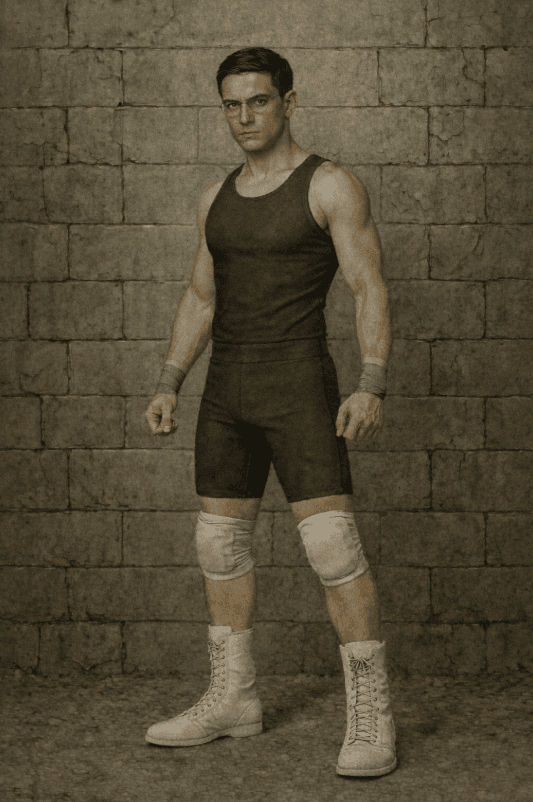
Hideo Kuramoto. Forty-two years old. Five feet ten inches, two hundred and five pounds. Two and three in this federation.
I want to address that record immediately, because it is the least useful number on the federation site and I expect the broadcast desk to lean on it.
It is not a measure of him. It is a measure of the men he has been assigned. He lost to Wone, who has beaten everyone. He lost to Mr. Cortez in a debut match against an opponent with no available tape. He lost to the inaugural World Champion. He has since taken Dorian Graves apart at the shoulder with a hooked-arm crossface, which is the most economical piece of work anyone has produced in this cage.
A man is not his record. A man is his method. Mr. Kuramoto's method is the most complete in this federation and I include myself in the comparison.
————————————————
II. THE DIFFICULTY
From the tape, in order of severity:
- His hands do not indicate. This is the entire problem and I will spend the rest of this document on it, so I will state it plainly first: twenty-three years of correct repetition produces a man whose movement contains no intention to read. He is not disguising anything. There is nothing to disguise. The movement is not a decision he is making; it is a thing his body does, the same way it did it four thousand mornings ago, and it arrives identically whether he has planned it or not.
- My work requires an opponent who is deciding. I locate the decision, I remove the alternatives to it, and the man arrives at the only remaining outcome believing he chose it. This is not a trick. It is arithmetic. But arithmetic requires values, and Mr. Kuramoto declines to supply any.
- He does not force. Opponents who face a narrowing possibility space will, without exception, attempt to force an option open. That attempt is the error I am waiting for. Mr. Kuramoto has never forced anything in twenty-three years. He will let me narrow the room to a single door and then he will walk through the door on schedule and do correct work on the other side of it.
- The crossface is not his finish. His finish is whatever the position has become by the time he decides to end it. Like Mr. Reyes-Montoya, he is not married to a setup. Unlike Mr. Reyes-Montoya, he will not be quicker than me.
I have been asked, by someone whose judgement I respect, what I intend to do about a man with no intentions.
The answer is that I intend to give him some.
A man who wants nothing cannot be read. So he must be made to want something. Not fear — fear is not available with him, it was trained out in a cold room before I was born. Wanting. There is one thing on this earth Hideo Kuramoto wants, he has never once concealed it, and he is one match away from it.
I am the last obstacle between a forty-two-year-old man and the only thing he has not done.
He will not be able to keep that out of the cage. It is not a decision he can decline to make. And the moment it is in there with him — the moment any part of him is fighting the match after this one — the movement acquires an intention, and I will be able to read it, and the room will begin to narrow.
————————————————
III. A PREDICTION, FOR THE RECORD
I am filing this before the match so that it can be checked afterward.
Mr. Kuramoto will have gone back to Japan. Not to train — he can train anywhere and has done so in twelve countries. He will have gone back to the room where he was made, to stand in it, and to be corrected by someone old enough to still be permitted to correct him.
They always go back. It is the single most predictable behaviour in this profession. A man approaching the thing he has organised his life around will return to the place that organised him, because he wants to be told, by the only authority he recognises, that the organising was not wasted.
I do not say this with contempt. I want that on the record too. It is a decent impulse and it will have been useful to him. He will return sharper than he left.
I say it because it is the most complete demonstration available of the difference between us, which is the actual subject of this document.
————————————————
IV. ON FORMATION
Mr. Kuramoto was made. I want the word used precisely. He entered a system at eighteen that had produced wrestlers before him and would produce them after him, and it applied itself to him for six years, and what came out the other side is a professional of extraordinary quality who did not select any part of the process. He is proud of this. He should be. It is the correct thing to be proud of if it is true of you.
It is not true of me. I selected.
I grew up in a house with an academic and a litigator in it. I was educated at a university my family approved of, in kinesiology and psychology, both of which I use daily and neither of which they intended me to use this way. I then went to the American southwest and asked a man to teach me this profession, and he agreed, and he was excellent, and I chose him off a list I compiled myself.
My family regarded the decision as a personal failure. They have not revised the assessment. I have never sought to correct them and I am not correcting them now — I mention it only because it is the relevant fact: nothing about my presence in this cage was arranged for me. There was no cold room I was placed in. There was no window that did not close. There was a young man with an unusual amount of information, deciding, repeatedly, against advice.
Mr. Kuramoto's position — and it is the position of most of that locker room, and it is honestly held — is that this makes me a tourist. That the paper trail matters. That a man who was formed by a system is more legitimate than a man who assembled himself out of one.
I would put it the other way, and I would put it in his own vocabulary.
A man who was made cannot take credit for the making. A man who selected can be asked, at any moment, whether he selected correctly — and he must answer, every time, with the work.
I have been answering that question since I arrived. Saturday I answer it against the best method in the building.
————————————————
V. THE OTHER WORK
Briefly, as before.
In my after-action filing I named that there is work in this federation that has been left unattended. I declined to specify it. I declined again on camera. I decline again now.
I will update the record on one point only. The work has reached the stage at which it can no longer be conducted by me alone. It requires the participation of a second person, who is aware of it, and who has stated publicly that he would be available for the conversation when the federation was ready to have it.
The federation is nearly ready.
————————————————
Mr. Kuramoto: I have read what is public of your volumes. Your framework is honest and it is verifiable, which I understand to be the standard you have set for professional exchange. I meet it. I am not asking you to accept me. I am telling you that on Saturday the room will get smaller, and that you will handle it better than anyone has, and that it will not be enough, because you want something and I do not.
The match will reveal what writing cannot.
— Evan Morse / "The Doctrine"