

Title: "A Service, Properly Rendered"
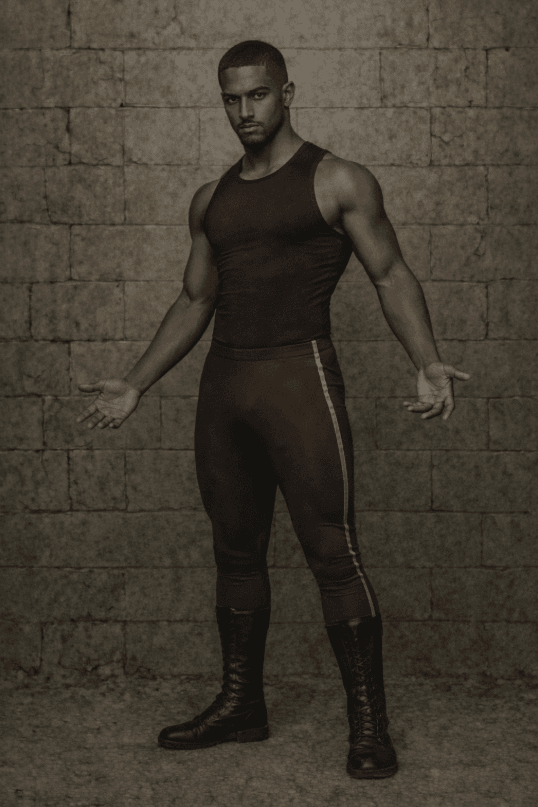
(Pryce is seated at a small table in what appears to be an empty training room. His blazer is on the back of his chair, not on him. Sleeves rolled to the elbow. In front of him, neatly, is a coffee cup, a small notepad — closed — and, incongruously, a plastic anatomical model of a human knee joint, which he handles throughout the promo with the easy familiarity of someone who has owned it for years. The accent is Bristol — soft, warm, precise. He smiles pleasantly when he begins, and the smile never fully leaves. He speaks the way a very good dentist speaks to a patient who is about to have a difficult appointment.)
Hello. Thank you for coming. Please — do sit down, if you'd like. No? All right.
(He adjusts the knee model slightly. Rotates it. Looks at it fondly.)
Lovely thing, this. My mother had one when I was a boy. She was a physiotherapist — did you know? Thirty-two years at the same practice. She could look at a person walking across a room and tell you, within six months, where they were going to have their first serious problem. It was not a trick. It was attention.
I come from attention, is what I'm saying. I was raised in it.
(He sets the knee down. Folds his hands on the table. Looks at the camera with genuine, open interest.)
I've been asked to say a few words about my opponent in the first round of the championship tournament. I'm told this is customary. So — yes. Of course. Happy to.
His name is Evan Morse. He wrestles as The Doctrine. I've had the pleasure of watching a great deal of his work in preparation for Friday, and I'd like to say, before anything else, that I find him genuinely admirable. That is not a joke and it is not a setup. I think he is very good at what he does, and I think the version of wrestling he is trying to practice — the meticulous, arguments-instead-of-moves version — is the correct version. On that, he and I agree completely.
(Small pause.)
Where we disagree, if you'll permit me, is on one small technical matter.
He believes he is the best practitioner of that style currently working.
He is not.
(He says this the way one might politely correct a guest about the time a train leaves. No emphasis. No relish. Just — the record being set straight.)
I don't expect him to accept that on my word. I wouldn't. If someone told me I was second-best at the thing I had built my life around, I would want them to demonstrate it. That is reasonable. That is, in fact, what Friday is for.
(He picks up the knee model again. Turns it so the camera can see the joint.)
May I show you something? It'll only take a moment.
This is the medial collateral ligament. This one — here. It stabilises the knee against lateral force. It is, as connective tissue goes, reasonably robust. It is designed to handle the loads a knee normally encounters in a normal life.
It is not designed to handle the load applied by a grown man's full bodyweight, rotating through a specific angle, while the ankle is trapped and the hip is extended. When that happens, the ligament does not tear cleanly. It shreds. In a particular way. It is actually quite difficult to repair well, and most patients do not recover full range of motion. They can walk. They simply cannot, afterwards, wrestle at a professional level.
(He sets the knee back down. Smiles politely.)
I am not threatening to do this. I want to be very clear. A threat is vulgar — threats are what men make when they are not confident the thing will happen. I am simply describing a piece of anatomy, and a set of mechanical conditions, and what the conditions produce when applied to the anatomy. It is information. It is freely available. Any physiotherapist will tell you the same.
What happens on Friday is up to Mr Morse. If he defends the leg correctly, nothing of this nature will occur, and I will have to find another route, which I will. If he does not — if his defence of the left knee is as academic as the rest of his work suggests — well.
Then a thing that was possible will have happened.
(He takes a sip of coffee. Considers.)
I want to return, briefly, to something I said earlier. That I admire him. I do. I think we agree about the fundamentals. I think we want the same thing from this business. And I think — and this is the part I suspect he will find most offensive, more offensive than losing — I think that on Friday night, when it is over, he will understand that the man who beat him was not a stylistic opposite but a better version of the same style.
That is the injury, really. That is the one that does not heal.
The knee can be rebuilt. The knowledge that someone else is simply better at the thing you thought you were best at — that one stays.
(He closes the notebook, which he never opened. Stands. Puts on the blazer, slowly, one sleeve at a time, adjusts the collar.)
A pleasure. Thank you for your time. Do give Mr Morse my regards, if you see him before the match. Let him know I've watched his tape. Let him know I found it educational.
(He picks up the coffee, nods once, courteously, and walks out of frame.)