
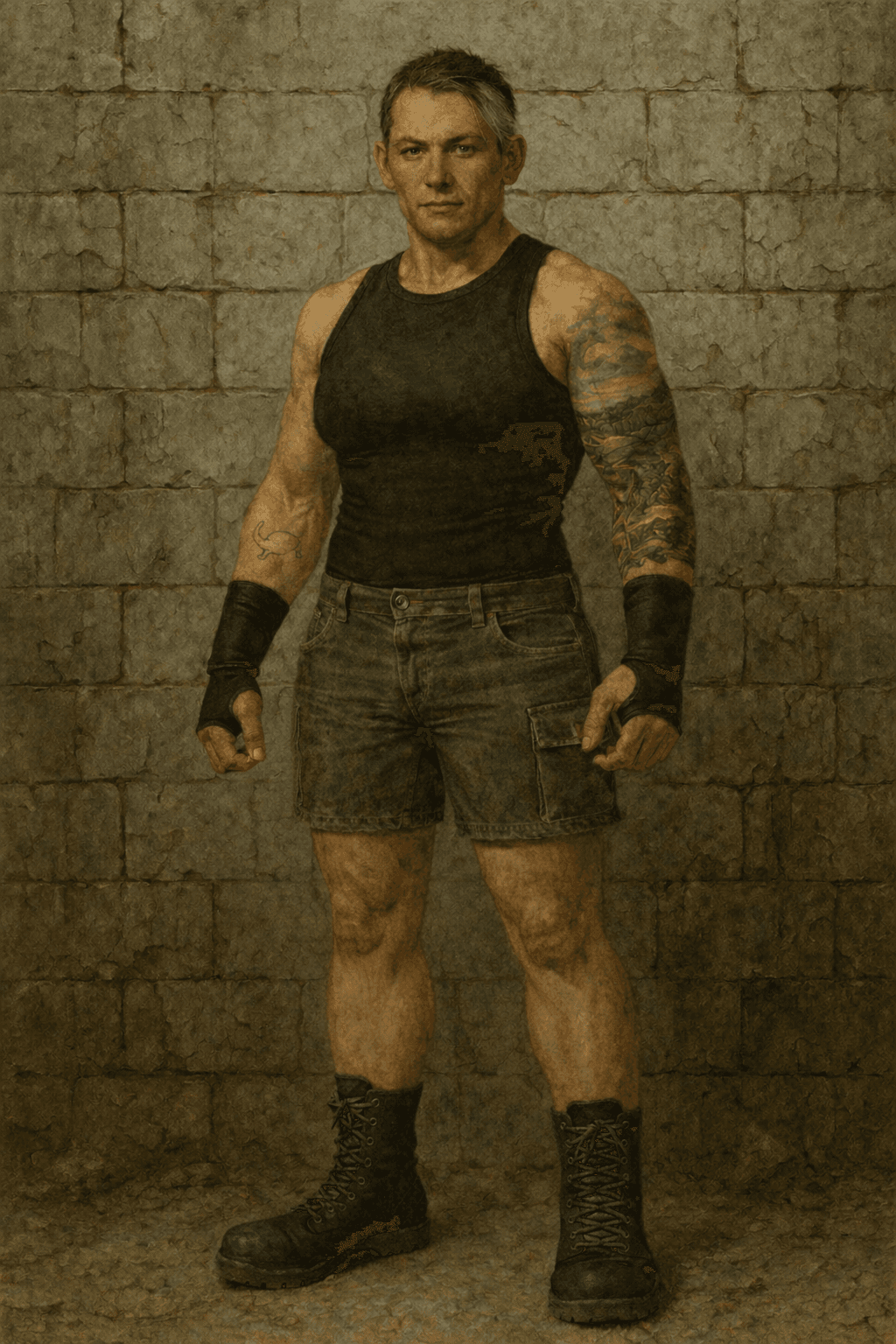
THE THIRD THING
[The kitchen table in rural County Clare. Same pine boards, scarred from years of use. The window above the sink shows the lower paddock gone dark — no sheep visible now, just the shape of the stone wall against a sky with one star showing through cloud. A packed duffel bag sits by the back door, mostly zipped. A blue mug of tea, untouched, gone cold. BRÍD Ó'SÚILLEABHÁIN sits with a photograph in front of her on the table — four by six inches, slightly creased at one corner. A converted bowling alley. No person in it.]
————————————————
I have had this photograph on the dresser since it arrived, and tonight, the night before I fly out for No Escape, I brought it down to the table instead, because I wanted to look at it properly one more time before I am in the same building as the man who took it.
Five hundred miles, there and back, in a day, to stand in front of a place neither of us had any earthly reason to visit for eleven years. I have turned that fact over more times than I probably should admit. I do not think he took that photograph for the federation's archive, whatever the federation's own note about it said. I think he took it because I asked him a question in a letter, and he is not, whatever else people assume about him from the tape, a man who answers a question with less than his whole self.
I still have not been to that bowling alley. I do not think I need to go now. He went for both of us.
————————————————
We have written to each other twice, and been read, once, on a broadcast, shaking hands with our first names finally spoken aloud instead of the ones the marquees gave us. And in all that — the letter, the photograph, the handshake — there is one thing we have not managed to do yet, which is the thing I actually asked for in the first place. We have not had the conversation. We have circled it beautifully. We have not had it.
I used to think that was a failure of nerve on both our parts. I have changed my mind about that this week, packing this bag.
I think the conversation was never going to happen at a table. I think I knew that when I wrote the first letter and it just took me two months and a second letter and a broadcast handshake to actually believe it. Clay and I do not have a shared language that lives in sentences. We have a shared language that lives in a cage, in front of people, with something in our hands that can do real damage if either of us decides it should. That is not a failure of the letters. That is what the letters were for — they cleared enough ground that the actual conversation could happen in the only grammar either of us has ever been fully fluent in.
So tomorrow, we have it. Properly. No Rancid in the corner to be the reason either of us can point somewhere else. Just the two of us, and whatever we have each decided, separately, over fifteen and however-many years, a line is for.
————————————————
I want to try to answer the thing that got said on the broadcast and never finished — the third thing, whether it can be passed down. I have been carrying that phrase around since BCD 8 the way you carry a stone in your boot, not painful exactly, just present, reminding you it's there every time you take a step.
Here is what I have worked out, sitting at this table, the night before.
Rancid has no line. That is not a flaw in him — I said as much before I fought him, and I meant it. Clay has one — drew it himself, after something he still will not discuss except to say it changed how he works. I have one too, drawn the same way lines like that always get drawn, which is by finding out first what is on the far side of not having one. Three of us, doing the same work, and only two of us decided, at some cost, where it stops.
The question was whether that kind of line — the decided kind, the kind that costs you something to hold — can be handed to somebody who has not paid for it yet. A fifteen-year-old in a front-row seat, say. A fighter starting out who has never once had to find out what the far side looks like.
I do not think you can hand it to them in a letter. I have tried, in a manner of speaking, and it took two letters and a handshake just to get two grown adults who already agreed with each other most of the way there. I think the only thing you can actually hand a fifteen-year-old is the sight of it being chosen, in public, by someone she already has a reason to watch closely. Not the lecture. The example. She will not remember anything either of us says tomorrow. She will remember, whether she knows it in the moment or only years later, what both of her father and I chose to leave alone with a room full of weapons in front of us and no one making us leave it alone.
That is my answer, for what it is worth. It may not be his. We can argue about it properly once the thing that actually needed testing has been tested.
————————————————
I am going to finish this tea cold, because I am not getting up again, and then I am going to sleep, because the flight is early and I am thirty-eight and no longer able to pretend that matters less than it does.
Clay — I do not know if you will read this before or after. It will not change what I do either way, and I do not think you would want it to.
I am glad we finally get the room.
— Bríd
Roleplay Archive
Diary / Blog Entry
The Third Thing
Filed by
Bríd 'The Bleeder' Ó'Súilleabháin
Words
1,036
Submitted
August 5, 2026