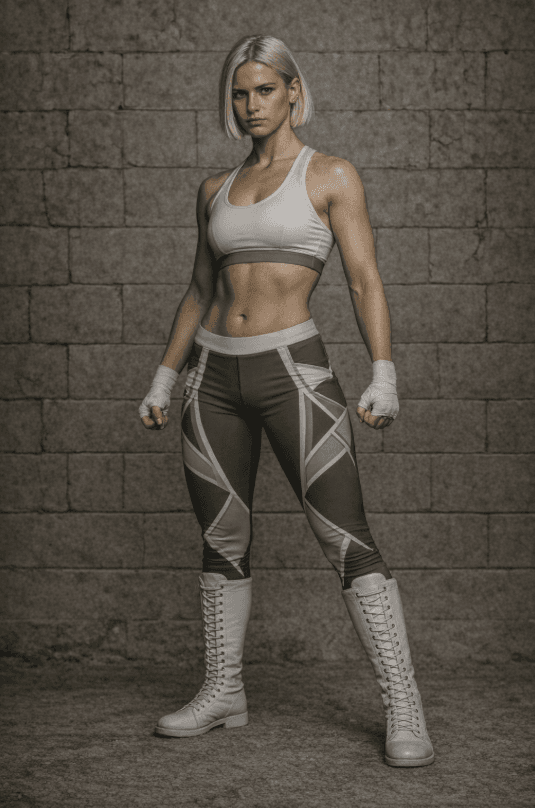
Sera Voss
Handler: jcbarr
8
Wins
1
Losses
0
Draws
Biography
Sera Voss does not have a gimmick. This is, in itself, something of a gimmick, but the distinction matters: other wrestlers perform detachment. Voss simply is detached, and the absence of performance makes it considerably more unsettling. She is a technical wrestler of the clinical school — not the school that emphasises flashy counters or satisfying reversals, but the school that treats the human body as a problem to be solved and solves it with the least dramatic means available. Her matches tend to be quiet. Not slow — quiet. She controls tempo through stillness rather than urgency, and her opponents frequently describe the experience of wrestling her as feeling like they are being taken apart by someone who finds the process only mildly interesting. In STRIFE, she is a heel by disposition rather than allegiance. She has no faction, no allies, no ongoing grudges. She identifies a match, arrives, competes, and departs. She has once been observed eating at the catering table. That is the full extent of documented social interaction. She is twenty-nine. She is not from here. Nobody has asked what she is from.
Attributes
Affects damage output of power-based moves
Affects speed, evasion, and aerial move effectiveness
Affects performance degradation over match length
Affects crowd interaction and promo-based match modifiers
Affects bonus multipliers from pre-match roleplay scoring
Affects match pacing decisions and comeback mechanics
Affects damage received from physical strikes and slams
Passive reduction of damage from counter-able move types
Passive reduction of effectiveness of submission holds
Move List
Finisher
Signature Moves
Class Moves
Universal Moves
Basic Moves
Career
Championships
1 reign · 68 total days held
Women's Champion
August 9, 2026 – present
68 days
Match History
Sera Voss (c) vs. Bríd 'The Bleeder' Ó'Súilleabháin — Women's Championship
singles · October 15, 2026
Lacey "Last Call" Drummond (c) vs. Sera Voss — STRIFE Women's Championship
singles · August 9, 2026
Sera Voss vs. Yusra Al-Nasir
singles · July 13, 2026
Sera Voss vs. Saoirse Fallon
singles · June 20, 2026
Sera Voss vs. Nia Adeyemi
singles · June 15, 2026
Sera Voss vs. Yusra Al-Nasir
singles · June 4, 2026
STRIFE Women's Championship — Quarter-Finals
singles · May 2, 2026
Saoirse Fallon vs. Sera Voss
singles · April 24, 2026
Entrance
Cold, minimal electronic music — not ambient exactly, but close. A regular pulse, a single descending synth line. The lighting goes to a pale, clinical white-blue over the entrance. Voss walks out at a measured pace, hands at her sides. She does not acknowledge the crowd, not through contempt but through the same focused inattention she gives everything that is not the match. She does not look at the stage, the titantron, or the cameras. She looks at the ring. She removes her gloves at ringside and places them on the apron. She enters through the second and third ropes, stands in her corner, and reviews the arena with the impersonal thoroughness of someone checking a workspace. Then she turns to her opponent and studies them for a long moment — not in a theatrical stare-down sense, but with the quality of someone confirming that the information they were given was accurate. Then she nods, very slightly, to herself, and the bell rings.
Backstory
Sera Voss grew up in Hamburg, the daughter of a structural engineer and a secondary school mathematics teacher. Neither background was accidental: the household ran on precision, on the understanding that correct answers existed and the expectation that you would find them. She took up judo at seven, moved into submission grappling at fifteen, and arrived at professional wrestling not through any particular love of the spectacle but through the observation that it was the most complete application of her skill set. She trained under two coaches — one German, one Japanese — whose approaches contradicted each other in style but aligned in rigour. The contradiction was useful. It taught her to derive first principles rather than follow systems. Her European career was steady and unpublicised. She worked the German and Austrian independent circuits, then spent two years in Japan, then a year in the UK. At no point did she develop a particularly interesting public persona, and at no point did she need to — her work in the ring communicated everything that needed communicating. She arrived in STRIFE on a short-term trial booking that extended into a full contract after her third match. Nobody asked her how she felt about that. She did not volunteer.
Gallery